Chapter 6: The Static March
Crossing the Veil

CHAPTER 6: THE STATIC MARCH
Outpost 47 – Missouri Quadrant
Local Time: 03:47 | Weather: Electromagnetic Fog, Low Visibility
The hum came back wrong.
Not the clean, invisible lattice of the Directorate network he’d grown up inside. This new rhythm dragged across his nerves like metal on bone almost stuttering, doubling back on itself, skipping beats as if it were learning how to be a heartbeat.
Cassian surfaced into it by force. Air tore into his lungs like he’d forgotten what it was for.
Elias’s face hovered above him, lined and grim, hands smeared with antiseptic and something darker. “You stopped breathing for half a minute,” the older man said. “That implant wasn’t just a tag. It was an interpreter. It taught your brain how to live with their noise.”
The room refused to settle. Outpost 47 appeared in layers: first as it was rusted beams, salvaged cabling, and generator glow, then overlaid by another version flickering in and out. In that second image, the walls pulsed with faint blue veins, wires embedded like roots, the ceiling bowing and rising as if the whole tower were drawing breath.
He blinked. The double vision stayed.
“Residual resonance.” Elias’s voice came from somewhere both near and far. “The Pulse doesn’t like being cut out. It’s knocking to see if you’re still home.”
At the doorway, Nadia leaned one shoulder against the frame. Her arms were crossed, jaw tight, eyes fixed on him like he was a grenade they’d already pulled the pin on. “You’re radiating,” she said. “I can feel it from here.”
Cassian tried to push himself upright. His muscles answered with a tremor that ran from his fingers to his spine. “I keep… hearing things.”
“Voices?” Nadia asked. “Or commands?”
He swallowed. His throat burned. “A phrase. Over and over.”
Elias reached for a battered notepad, the habit of a man who had once recorded data instead of casualties. “Say it.”
Cassian shut his eyes. The words were there, like foreign text burned into the inside of his skull. “Find the boy,” he murmured. “He knows how to wake the dead.”
Elias went very still. The generator’s thrum suddenly sounded too loud. “They used that line in the early days,” he said at last. “Back when they still pretended Project Eidolon was about rescuing soldiers. They told the families the Reaper would bring their sons home in… new ways.”
Nadia’s mouth twisted. “And instead the sons went into machines and mothers got a medal.”
Cassian’s head pounded. “Project Eidolon,” he repeated. The name rang faintly familiar from an acronym in an old file, a line he’d glossed over in academy studies. “That’s Directorate myth. Half the records are classified, the rest are propaganda.”
“Not myth,” Elias said. “A chrysalis. Your father helped spin it.”
The hum in Cassian’s skull rose a pitch, as if in agreement.
Sleep became less an option and more an intermittent system crash.
He would doze for seconds and slam awake, heart pounding, body convinced it had been underwater. Outpost 47’s shadows lengthened and folded in strange directions. The generator’s rhythm wouldn’t sync with his breathing, no matter how he tried. Every time he closed his eyes, the orchard waited.
Rust and lavender sky. Rows of trees with naked branches, each limb hung with mirrored shards that didn’t move in the wind. They seemed to respond to something else-some deeper pressure, as if they were turning their attention rather than their weight.
He walked the same path over and over, boots sinking into black loam that felt warm and faintly alive. With each step, different shards lit: a hand signing off on a redacted MSI file; a boy in a concrete yard tracing spirals in the dust; a woman strapped to a table, singing through her teeth as wires kissed her temples.
Nadia and Elias’s voices echoed faintly at the edges of it sometimes, calling his name, dragging him back.
One time, they didn’t.
The seizure came early, before the sun had even hinted at the horizon.
He was sitting by the stove, wrapped in a blanket that smelled as much like metal as wool, when the hum climbed into a shriek only he could hear. His vision pixelated. The room split along a line only his nerves understood. His body tried to stand and instead folded, gravity spinning sideways.
Hands caught him; Nadia’s voice sharp, Elias calling for a stabilizer, someone swearing in a language he didn’t know. The floor was freezing against his cheek. The scar at his temple burned like a fresh brand.
And through all of it, beneath it, around it, the orchard.
The trees loomed closer this time. The shards no longer waited; they spun faster than his thoughts, flickering scenes too quick to catalog. Faces. Numbers. The old Directorate emblem was painted over with the newer insignia of the Division of Cognitive Order: a fractured spiral through a broken sunwheel. The words Mnemonic Severance Initiative are stamped on a folder. A word scribbled in the margin in someone’s furious hand: HARVEST.
He reached for the nearest shard. It flared under his palm, white-hot.
For a moment, he wasn’t in the orchard at all.
White lights. Tile that smelled of bleach and recycled air. The low, wet beep of outdated monitors.
He stood; no, hovered, in a glass-walled observation room, as if his mind had been dropped into a memory he wasn’t supposed to see. Beyond the glass, a man lay strapped to a welded chair, arms bound, head cradled in a crown of metal. Lines ran from the crown to a lattice of tubes above him, each faintly luminous.
The placard on the wall read: PROJECT EIDOLON – PHASE III
Below it, smaller: MSI PATIENT 027-B: VOLUNTARY SUBJECT, PTSD CLASSIFICATION.
A younger Elias stood in the corner, hands full of printouts, face pinched. At the foot of the chair, a researcher barked commands in Reich German.
And at the center of it all, hand hovering over a console, eyes hollow with genius and exhaustion—was a man Cassian knew better as a portrait than a person.
His father.
Not heroic. Not mythic. Just… tired. Haunted. Wearing a lab coat that didn’t sit right on his shoulders.
Cassian tried to speak. To slam a hand against the glass. Nothing moved. He was a ghost inside someone else’s memory.
“Begin dream induction,” someone said.
The man in the chair began to hum a lullaby under his breath, voice shaking.
Cassian’s father leaned in, almost tender. “You’re safe,” he said in the language of reassurance, not command. “We’re just helping your nightmares go somewhere they can’t hurt anyone.”
“And where is that?” Elias, young, still soft around the eye, asked.
His father answered without looking at him. “Somewhere we can measure, and manage, and make use of.”
The crown lit. The tubes above the chair brightened as if filling with liquid light. On a nearby monitor, waves of brain activity flattened into something orderly, almost beautiful.
“Eidolon stream stabilized,” a technician announced.
The lullaby stopped.
The man in the chair exhaled once and went utterly still—not sleeping, not waking, just absent.
Something else. Something wrong, began to move behind his eyes.
The orchard snapped back around Cassian like elastic. He was on his knees in the loam, chest heaving. Elias’s voice bled through from somewhere far away, shouting his name. Nadia’s hand gripped his shoulder hard enough to bruise.
“Stay with us!” she yelled. “Vale, look at me!”
He tried. His body didn’t answer. The scar at his temple pulsed in time with the token in his fist. He realized, dimly, that he’d clutched it so tightly his palm was bleeding around the edges.
The orchard changed.
The trees thinned toward a distant clearing he’d never reached before. Through the branches, he saw a sliver of something that wasn’t rust or lavender sky. It was pale gray, like fog over snow, like the world beyond the Frostline.
A figure stood there. Small. Still.
A boy.
He couldn’t have been more than twelve. Dark hair to his jaw, eyes too old for his face. He wore a mismatched coat patched at the elbows and a string of tokens around his neck made from bones, metal, bits of glass, each etched with tiny symbols. One hand rested lightly on a fallen shard embedded in the soil like a gravestone.
The boy looked straight at Cassian. Not through him. At him.
“You’re late,” he said. His voice was the same one that had threaded through the static, calling from somewhere beyond the Veil. “They took too much from you before you ever got here.”
Cassian tried to step toward him. His legs wouldn’t move. “Ruel,” he said-or thought he did. He wasn’t sure if the word made it past his throat.
The boy’s mouth crooked in something that wasn’t quite a smile. “You don’t have the right to my name yet.”
Behind the boy, the light warped.
At first, Cassian thought it was just the sky folding in on itself, but then he saw the lines: arcs of wire, like a crown gone feral, radiating from a point in the air where nothing should exist. A shape coalesced that was tall, draped in something that wasn’t a coat but moved like fabric rendered from static. Wires trailed from where its ears should be into the soil and up into the hanging shards.
Most terrifying was the face.
It didn’t have one at first. It had multiple. Features flickered and overlapped: his father’s tired eyes, the man in the chair’s slack mouth, a dozen other profiles layered like bad transparencies. Then, slowly, they all turned toward Cassian and settled, overlapping into something new.
Not a man. Not a machine. The pattern of both.
The Reaper.
He knew it, the way a body recognizes its own reflection in a dark window.
When it spoke, the sound didn’t come from its mouth. It came from every shard at once, from every memory it had eaten.
“You shouldn’t be here yet,” it said.
Cassian’s heart slammed against his ribs. “I didn’t come for you.”
The Reaper tilted its head, wires humming. “You are built from me. Your father fed me soldiers. Then prisoners. Then civilians. You are heir to the experiment, little echo.”
Beside the Reaper, the boy stood unnervingly calm. One of the tokens at his throat glowed faintly, pulsing counter to the Reaper’s rhythm defiantly and discordantly.
“You don’t own him,” the boy said, glaring up at the towering figure. “You don’t own all of us.”
The Reaper’s attention slid between them like a knife choosing which ribs to slip through.
“Project Eidolon was designed to erase contradiction,” it said. “To make one mind from many. But you…” Its gaze locked onto Cassian, and for the first time, he truly felt what it meant to be noticed by something that lived inside thousands of stolen dreams. “You are noise. An error in inheritance.”
The orchard dimmed. Rust and lavender drained to monochrome.
Cassian tried to tear his attention away, to turn toward the boy, to ask him how to fight this thing, how to find him in the waking world, how to-anything.
“Don’t answer it,” the boy said sharply. “Not here. Not yet.”
Answer what? Cassian wanted to ask, but the Reaper was already moving, not with its body, but with the entire orchard. Shards spun faster, catching fragments of Cassian’s own life now: his first day in the Directorate academy; his father’s hand on his shoulder during a ceremony; the first time he authorized a Level 7 Mnemonic Severance file without reading past the summary.
“Let me see what you love,” the Reaper said, almost curious. “We’ll build something useful from it.”
Every shard flared.
For a moment, he saw himself as a boy staring up at his father’s portrait, believing the caption beneath: Architect of Stability. He saw the pride. The certainty. The monstrous comfort of it.
Shame scorched through him so intensely he thought his skin might split.
“No,” Cassian said, not loud, not brave, just honest.
It was enough.
The token in his fist blazed, so hot it should have charred bone. Cold rushed into the orchard like floodwater. The trees screamed, not in sound, but in shattering. Shards dropped from branches, falling in slow-motion rain.
The Reaper’s outline glitched. For the first time, Cassian saw something like surprise flicker through its impossible face.
The boy’s eyes flashed with it, too, but in his, it looked like relief. “Good,” he said. “Remember that feeling. You’ll need it when you cross the Veil.”
The orchard cracked, and Cassian slammed back into his body.
He was on the floor of Outpost 47 again, back pressed against cold metal, lungs working like bellows. Nadia was crouched in front of him, fingers digging into his shoulders hard enough to hurt. Elias hovered just behind her, a sedative injector in his trembling hand.
“What happened?” Nadia demanded. “You went rigid. Your eyes”
“Were somewhere else,” Elias finished softly. “Where did you go, Vale?”
Cassian blinked. The world came back in pieces. First the stove, then the humming generator, the damp grit of the concrete under his palms. The hum in his head had dropped to a low, sour throb.
He wiped his nose with the back of his hand. Blood smeared warm across his skin. His other hand was curled so tight around the token his knuckles had gone white. When he forced his fingers open, he saw angry crescent cuts where the edges had bitten his palm.
“I saw… an Eidolon lab,” he said quietly. “My father. A test subject. And something else.”
He looked toward the north wall, as if he could see through it, through the Relay Fields, all the way to the pale band of the Frostline and the unseen strip of reality they called the Veil.
“Something from the Sleep Harvests didn’t stay in the machines,” he said. “It learned to move. It’s still moving. And it knows I exist.”
Nadia stared at him. “The Reaper.”
He nodded once.
Elias sank onto a crate as if someone had cut his strings. “We used to joke,” he said hollowly, “when they first whispered about Project Eidolon. We said, ‘What’s the worst that could happen? A ghost in the machine? He laughed once, without humor. “We didn’t think the machine would like being a ghost.”
Silence settled over them, heavy and waiting.
At last, Nadia spoke. “You said there was something else.”
Cassian hesitated. The boy’s eyes burned behind his own. “Someone else,” he corrected. “A child. Maybe not anymore. He’s on the other side of whatever that thing is, and he’s carrying tokens like this one.”
He held up the blood-slicked shard.
“He told me I was late.”
Nadia exhaled through her nose. “Rebellions always say that about their saviors.”
“I’m not your savior,” Cassian said.
“Good,” she replied indignantly. “We don’t need one. We need someone who can walk into the Veil without going hollow.”
The hum in his skull shifted, as if offended by the idea.
Cassian pushed himself to his feet. His legs shook, but they held. “Then I’ll go north,” he said. “I find where Project Eidolon bled into the Frostline. I find the boy. And I find out why the Reaper wanted me to love it before it fed.”
Elias studied him for a long moment. “You understand what happens if it gets its hooks in you out there? There’s no Pulse grid to filter you, no implant to buffer. If it takes too much, you won’t even know you’re gone.”
“I’ve been living as someone I didn’t know for twenty-eight years,” Cassian said. “Maybe losing him isn’t the worst thing that could happen.”
Nadia’s expression flickered with something like respect or resignation. “You leave at dawn,” she said. “Pack light. The land between here and the Veil doesn’t like company.”
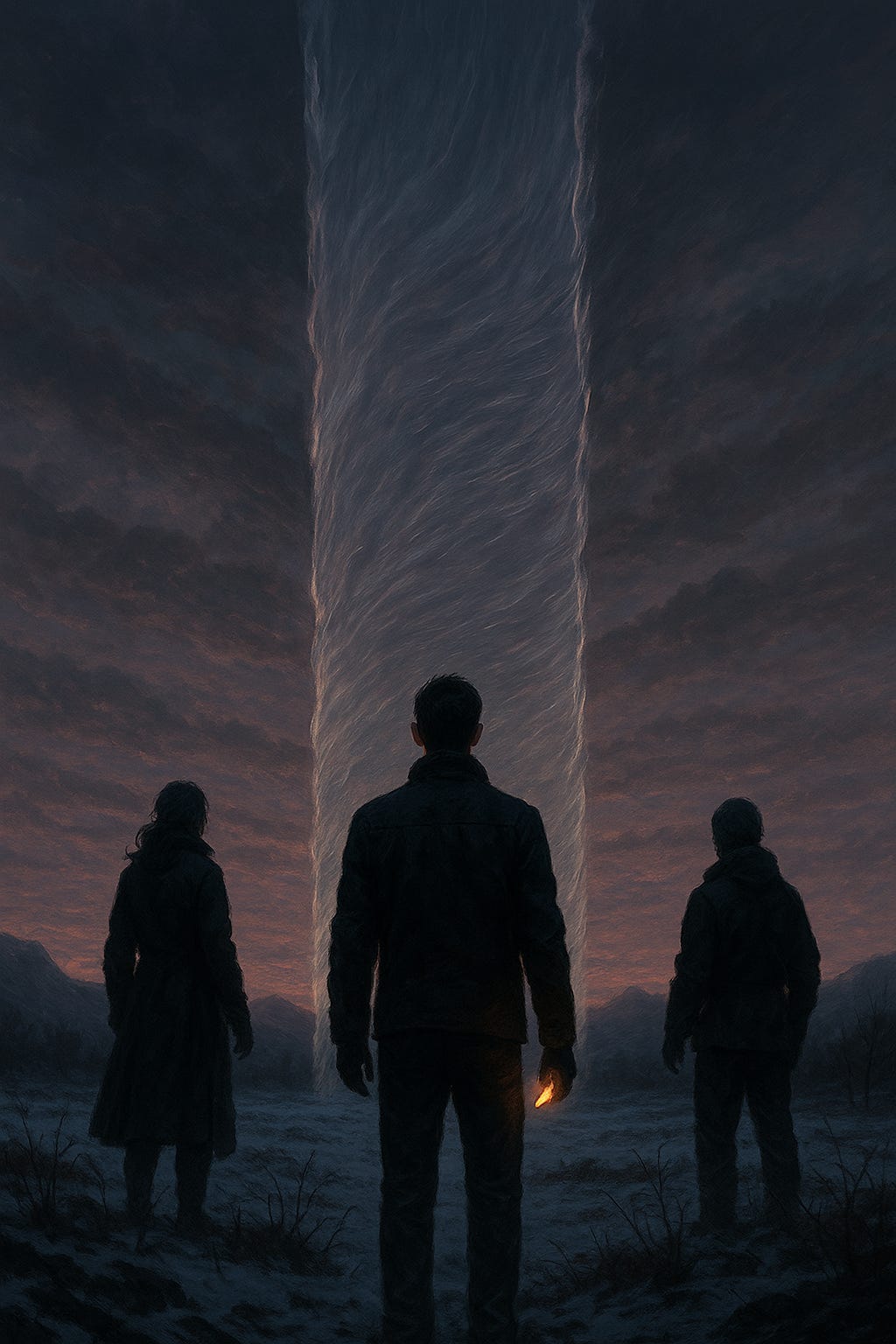
Dawn bled weakly through the broken slats of the relay tower, turning the snow outside the gates into bruised light.
Tavi was the only one who looked anything like hopeful. He pressed something into Cassian’s palm before he left. In his hand was a small charcoal glyph on a scrap of plastic, the Bridge spiral he’d seen etched in ash the night before.
“So the land knows who’s walking on it,” Tavi said. “And so we know if you stop.”
Cassian tucked it into an inner pocket beside the token.
Nadia walked to his left. Elias trudged at his right, each step a small war against an old injury. Behind them, Outpost 47 shrank into a smudge of smoke and shadow, the last place in the Pulse’s shadow where Cassian could have pretended to be nothing more than a man who’d made a mistake.
The world ahead didn’t care who he’d been.
The road north was less a road and more a sequence of scars.
They moved through fields where rusted reaper machines-literal ones, designed to cut wheat, not memory-sat abandoned, their blades warped. Past them, the silhouettes of weather-mod towers pierced the low sky, their vanes frozen at odd angles. Some still hummed faintly, trying and failing to pump equilibrium into air that had long since chosen sides.
Along one ridge, concrete bunkers jutted from the snow like broken teeth. They were painted with faded murals: smiling soldiers reclining in stylized helmets, eyes closed, mouths soft. Above them, an old slogan curved in three languages:
DREAM WITHOUT BURDEN.
Underneath, someone had spray-painted a single word in red:
HARVEST.
Cassian stopped in front of it. The humming in his skull spiked, like a tuning fork struck against bone.
“I saw this room,” he said. “Not this exact one, but the idea of it. In the orchard.”
Elias brushed snow from a corner of the wall, revealing a stamped code. “This was an auxiliary node,” he said. “Back when Eidolon was still pretending to be medicine. They took war-trauma cases here. Told them the MSI would lighten their load. They didn’t say someone else would be carrying it for them as entertainment twenty years later.”
Nadia spat into the snow. “Sleep Harvests,” she said. “That’s what my grandmother called it. Said if you signed the papers, you went to bed as yourself and woke up… less.”
“Less?” Cassian asked.
“Like a song with missing lines,” Nadia said. “You still recognize the tune. You can’t remember why it mattered.”
They moved on. The hum followed.
By midday, the horizon changed.
The air ahead took on a flat, pale sheen, like glass seen edge-on. The temperature dropped sharply enough that their breath crystallized close to their faces. Sound dulled; even the crunch of their boots felt muffled, as if the world had packed snow into their ears.
“The Veil,” Elias murmured. “Old front line, new fault line.”
The hum in Cassian’s skull split in two: one part still the Pulse’s distant complaint, the other something stranger, deeper, and older. Between the two, his thoughts felt stretched thin.
He didn’t notice the drone until Nadia yanked him sideways.
A sleek, skeletal shape sliced through the washed-out sky, wings tuned to catch frequencies human ears weren’t supposed to parse. Its underbelly was a cluster of cameras, lenses dilating hungrily. Symbols were etched along its frame-recycled insignia, the fractured spiral of the Division of Cognitive Order tangled with smaller marks Cassian recognized from Tavi’s charcoal glyphs, bent and misused.
“It shouldn’t be able to fly this close to the Veil,” Elias hissed. “Signal decay should scramble-”
The drone let out a tone that was less sound and more pressure. Cassian’s teeth ached. His scar seared. The thing was scanning, tasting for a frequency.
For his frequency.
Reaper spillover, his body whispered. Eidolon scavenger. A listening machine sent to follow errors.
He felt the token heat in his pocket before he touched it. When his fingers wrapped around it, the token’s pulse synced not with the Pulse, but with the boy’s voice echoing from the orchard.
Not yet. Not here.
The drone dipped, then corrected, clearly confused. Its cameras turned toward Cassian in unison. For a heartbeat, every lens reflected a different version of his face: Directorate uniform, child in academy gray, man kneeling with blood on his temple while a scarred mechanic cut out a humming light.
Cassian gritted his teeth and squeezed the token harder.
Something answered from somewhere beyond the Veil, from the orchard, from the part of himself left floating between them. It wasn’t language. It was a refusal.
The token flared.
The drone spasmed mid-air, wings stuttering as if someone had run a magnet through its circuitry. The tone it had been emitting snapped off, leaving a vacuum in its place. It dropped from the sky like a stone, smashing into the snow and carving a shallow trench. One wing snapped. One camera popped free, rolling to a stop at Cassian’s feet like an eye torn from its socket.
Nadia was moving before the thing finished skidding. She plunged a knife into its core, severing the faintly glowing lattice inside. The smell of burnt plastic and ozone rolled over them.
When it finally went still, they all just stood there for a second, listening to the sudden absence of noise.
Elias exhaled. “That,” he said, “was not supposed to be possible.”
“What, the drone?” Cassian asked. His voice shook more than he liked.
“No.” Elias pointed at the token still clutched in Cassian’s hand. “That. Whatever you just did.”
Cassian opened his fingers slowly. The token had cooled, but the skin of his palm was red and angry. “I didn’t do it,” he said. “Something using me did.”
Nadia nudged the drone corpse with her boot. “Then something on the other side of the Veil just chose a side.”
They didn’t talk much after that. The land demanded too much attention. The closer they drew to the Veil, the more the environment felt… undecided. Trees grew at wrong angles. Snowdrifts formed in curves around invisible obstacles. Once, Cassian watched his own breath go sideways, drifting toward a point in the air and vanishing.
Every so often, the orchard would flicker at the edges of his vision; not fully, just enough to remind him the Reaper now knew exactly where his mind lived.
And every so often, beneath the Reaper’s looming presence, he felt something else. A smaller pulse. A boy’s steady defiance. The faint chime of tokens clicking together in the dark.
By the time the sun slid into a smear behind low cloud, the Veil was no longer a concept on the horizon. It was a wall.
It didn’t shine. It didn’t glow. Instead, it distorted.
The air ahead bent like heat over metal, except there was no warmth in it. Sound died as it touched that invisible surface. The world on the far side looked slightly wrong. The colors were too muted, and the shadows were a fraction of a second out of step with the forms that cast them.
Cassian stopped. His body remembered being on an observation platform in the Directorate tower, looking down at cities neatly mapped by light. This felt like staring at a map of his own skull.
Nadia’s breath feathered the scarf at her mouth. “Once we step through,” she said quietly, “there’s no more grid. No more fallback. No more comfort in being watched.”
Elias, eyes on the Veil, added, “And whatever survived of Project Eidolon didn’t leave because it was told to. It left because it liked the dark better.”
Cassian thought of his father’s hand hovering over the console in the lab. The man in the chair going still. Of the lullaby dying on his lips.
He thought of the boy in the orchard, tokens glowing, standing between the Reaper and the falling shards.
“You’re late,” the boy had said.
Cassian rolled the token between his fingers. It pulsed at a tempo that felt nothing like the Pulse network and everything like a heartbeat, learning how not to be controlled.
“I won’t be late,” he said.
He took a step toward the Veil.
The hum in his skull rose, not in protest, but in recognition, like a system that had been waiting for this particular error to appear at this particular edge.
For a second, the orchard overlaid the Veil so perfectly he couldn’t tell where one ended and the other began. Trees without leaves. Shards instead of fruit. The Reaper’s many-layered face turning toward him. The boy’s eyes burning bright, refusing to look away.
Let me see what you love, the Reaper had said.
“No,” Cassian whispered now, before it could ask again.
The token flared once, answering the word as if it were a command.
The Veil pulsed, a barely visible ripple running across its strange surface.
And then, with Nadia at his side and Elias at his back, Cassian walked forward until the world bent around him and the Pulse behind them finally, truly, fell silent.
Dear Reader,
I hope you’re enjoying watching Cassian’s character develop as he connects the dots. I’m excited for the characters introduced, and for what lies ahead with our anti-hero, and I hope you are, too!