CHAPTER 9
The Path That Wasn't There

Inside the Veil
Unknown Depth
Environmental State: Unstable Alignment
They should not have followed it.
Nadia said as much more than once, though her voice had shifted from sharp resistance to something quieter, more deliberate. The orchard had a way of doing that. It did not argue with you. It wore you down until your instincts started to feel negotiable.
“We don’t chase voices in places like this,” she said, her gaze moving constantly between the trees, tracking movements that were not quite movements. “That’s how you disappear without realizing it.”
Cassian kept walking.
“He’s not a voice,” he said. “He’s here.”
“That’s worse.”
Behind them, Elias slowed, studying the orchard itself rather than the space ahead. His attention drifted upward, following the suspended shards as they turned in place. They were not drifting anymore. They were adjusting. Subtle shifts in angle, one after another, forming a pattern too precise to be random.
“He’s not wrong,” Elias said quietly. “Something is reacting to him.”
Nadia did not turn. “That doesn’t mean we follow it.”
Cassian barely heard them.
The pull had changed.
It was no longer direction, at least not in any way a map would understand. There was no visible path, no opening between the trees that promised movement forward. And yet something beneath his thoughts, deeper than instinct, was aligning him with something ahead. It felt less like being called and more like being tuned.
The orchard changed slowly.
At first, it was just the spacing. The trees seemed to pull back by inches, opening a narrow band through the loam. Then the shards followed. One by one, those closest to Cassian tilted, catching the dull rust-colored light of the sky and bending it into narrow lines that stretched across the space in front of him. More followed, each adjustment echoing the last just enough to suggest repetition. Not a path, exactly. Not something built, but something emerging.
A corridor shaped by alignment.
“You see that?” Elias asked.
Nadia nodded, her grip tightening around the handle of her blade. “Yeah,” she said. “I see it.”
She did not like it.
Cassian stepped into it anyway.
The moment his foot crossed into that space, the hum inside his skull fractured. The tones separated sharply, pulling apart in opposite directions. One dropped low and steady, dragging at his chest. The other rose high and erratic, slipping out of sync faster than he could track.
His vision followed.
It did not blur.
It split.
White light flooded everything.
Not from above. Not from any single direction. It erased depth entirely, flattening the world into sterile brightness.
A child sat at a metal table.
His legs hung just above the floor, unmoving. Wires trailed from behind his ears into a console that pulsed faintly in time with his breathing. The room smelled clean, but beneath it, there was something else. Metallic and warm. Human, though everyone in the room pretended not to notice.
“Subject shows unusual coherence,” a voice said beyond the glass. “No compound required.”
The child tilted his head slightly, listening.
Cassian felt something tighten in his chest. Recognition without memory. Not the recognition of a face, but of a wound touched in the dark.
Then the scene tore away.
He stumbled back into the orchard, lungs dragging in air that felt thicker than before. Nadia caught him with a firm hand against his shoulder, grounding him before his knees could fold.
“Stay with us,” she said.
“I am,” he answered, though the words did not feel anchored.
The orchard reacted.
The ground shifted beneath them. Not violently. Not randomly. Deliberately. The loam lifted in slow, uneven ridges, rising into folds that broke the natural plane of the ground. The texture changed as it moved: soft and granular one moment, dense and resistant the next, as though the earth were testing different states of being.
Then the trees responded.
Branches lowered, not bending under weight but adjusting inward. Closing distance. Narrowing space. The corridor Cassian had stepped into tightened around them, its edges no longer passive. Above, the shards accelerated. What had once been a slow, deliberate rotation snapped into motion. Their edges blurred, reflections smearing into streaks of fractured light. The soft chiming that had filled the orchard sharpened into a high, overlapping resonance that pressed against the inside of the skull.
Not sound.
Pressure.
“What did you do?” Nadia shouted.
Cassian tried to answer, but the tones inside him had slipped too far apart. The alignment was gone. The corridor was not collapsing.
It was unraveling.
Nadia lost her footing first. The ground beneath her shifted at an angle that should not exist, folding downward while simultaneously pushing sideways. Her leg slipped into the distortion, disappearing past the knee into something that looked like soil but behaved like absence.
“Cassian!”
Elias lunged, catching her arm, but the distortion spread outward from the point of collapse, warping the ground beneath both of them. Cassian saw it happen with terrible clarity. He did not understand the mechanics of it, not really. He only knew the corridor had responded to him and now punished everyone near him for his ignorance.
His body moved before his mind could name the decision.
The shard dropped at his feet.
It did not fall from above. It arrived, striking the loam with a soft, deliberate sound that carried through the chaos. Waiting.
Cassian grabbed it.
Everything aligned.
The opposing tones in his skull snapped together, locking into a single, stable resonance that ran through him like a second spine. The pressure that had been building since crossing the Veil vanished, replaced by something structured. Controlled. The orchard responded instantly. The spinning shards slowed, then corrected, their motion falling back into precise, measured rotation. The piercing resonance collapsed into a low, steady hum that matched Cassian’s breathing.
The ground beneath Nadia hardened just enough for Elias to pull her free.
The distortion withdrew.
Not gone.
Contained.
Nadia pushed herself upright, breath unsteady, one hand still gripping Elias’s sleeve. Whatever passed for mud here clung to her leg in black strands that moved a little too long after she was free. She stared at Cassian as if he had become another hazard in the landscape.
“You’re going to get us killed,” she said.
Cassian stared at the shard in his hand. It pulsed faintly, warm against his skin.
“I didn’t mean to.”
“That doesn’t matter here.”
Elias stepped closer, but he did not look at Nadia or the ground. He looked at Cassian with the expression of a man recognizing a theory he had prayed would remain theoretical.
“You destabilized the corridor,” Elias said slowly. “Then you corrected it.”
Cassian shook his head. “I don’t know how.”
“I know,” Elias said. “That’s what worries me.”
The air shifted again.
Not violently. Not reactively. Deliberately.
The boy stood ahead of them.
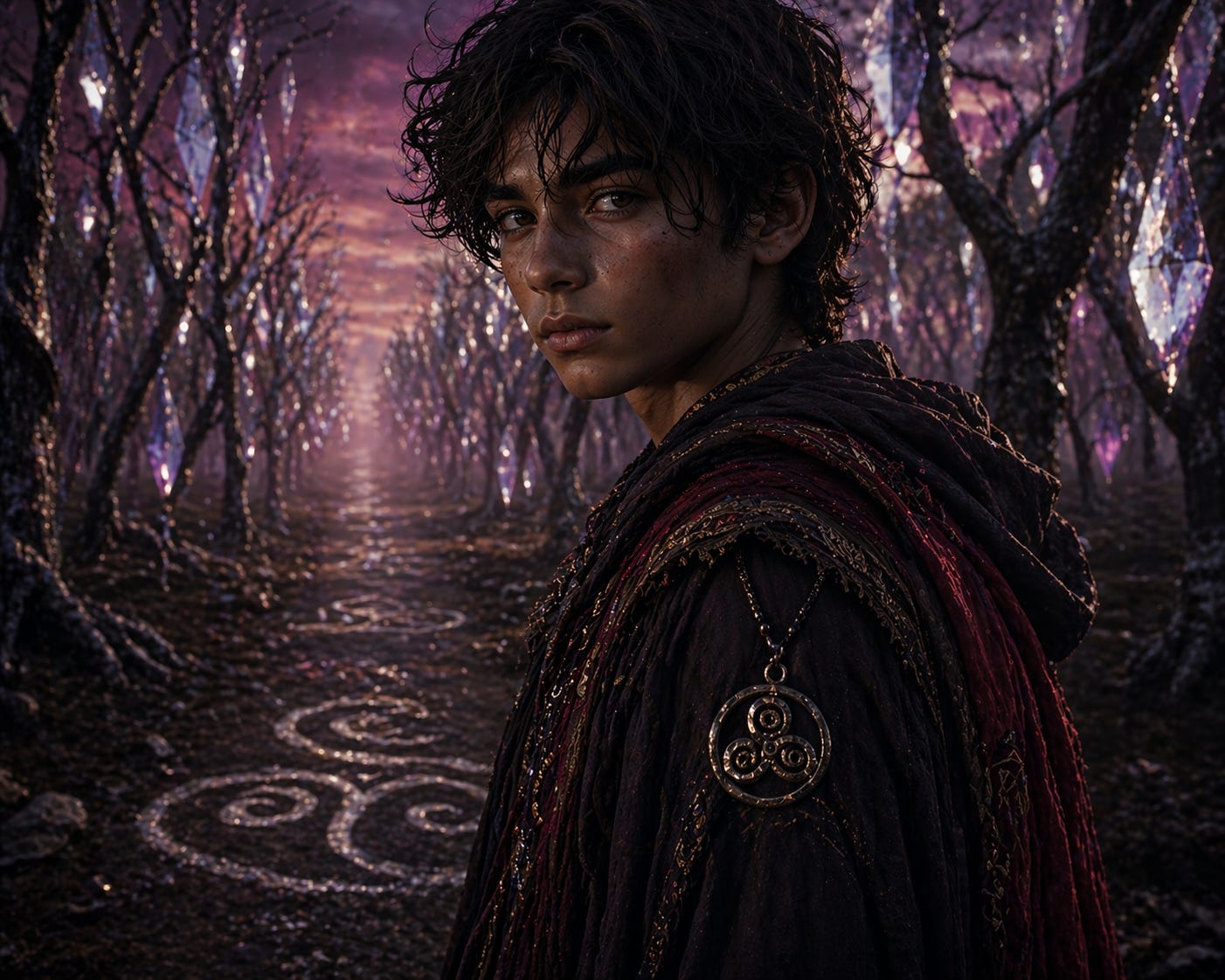
This time, there was no flicker. No distortion. No question of whether he was there. He was small, yes, but not fragile. Dark hair fell just past his brow. A string of tokens rested against his chest: bone, metal, glass, bits of unknown things etched with tiny symbols that seemed to hold their own weather. One hand rested against a shard embedded in the air beside him, as if the shard were a doorframe and he was waiting for Cassian to decide whether he had manners enough to knock.
His eyes settled on Cassian.
Not afraid. Not curious.
Evaluating.
“You don’t know how to walk here,” he said.
The words did not travel through the air. They arrived fully formed inside Cassian’s head, precise and unambiguous.
Cassian took a step forward despite himself. “Then show me.”
The boy’s expression did not change. “Not yet.”
His gaze flicked briefly to the shard in Cassian’s hand, then back to his face.
“You break things when you don’t understand them,” he said. “Out here, that doesn’t just hurt you.”
Cassian swallowed. “I didn’t mean to.”
“I know.”
The simplicity of it carried more weight than accusation. Nadia stepped forward slightly, placing herself just off Cassian’s shoulder. She was still breathing hard, still pale from the distortion that had tried to swallow her, but her blade stayed low instead of raised.
“Who are you?” she asked.
The boy did not look at her. His attention never left Cassian.
“You are still listening to the wrong voice,” he said.
The same words.
But this time, they felt directed. Intentional.
Cassian’s grip tightened around the shard. “Then tell me which voice is yours.”
The boy’s eyes narrowed slightly, and for the first time, something like anger crossed his face. It did not make him look younger. It made him look older than Elias.
“You want names like they are keys,” he said. “Names are doors. Doors are obligations. You don’t get mine because you found the path by bleeding on it.”
Nadia’s jaw tightened. “We didn’t come here for riddles.”
“No,” the boy said, still watching Cassian. “He came because the thing in the orchard noticed him and he mistook fear for purpose.”
The words struck because they were too close to the truth.
Cassian opened his mouth, then closed it again. A dozen responses moved through him, each one trained by the Directorate: denial, deflection, assertion of authority, demand for explanation. They all felt suddenly useless.
Elias spoke instead. “If you know what he is doing, then you know we need guidance.”
The boy’s eyes moved to Elias for the first time. Something shifted there. Recognition, perhaps. Or disappointment.
“You were there when they first opened the wrong door.”
Elias went still.
The orchard around them quieted. Even Nadia seemed to feel the change, because she looked from the boy to Elias with sharp suspicion.
“I was a technician,” Elias said quietly.
“You were a witness,” the boy replied. “There is a difference only cowards find useful.”
Elias flinched as if the words had physical weight.
Cassian expected Nadia to snap back. She did not. Her gaze stayed on Elias, and in the silence that followed, the outpost, the fires, the relay tower, the whole fragile trust they had built seemed suddenly farther away.
The boy stepped back.
The orchard dimmed.
Not darker.
Deeper.
“If you want answers,” he said, “keep walking. If you want forgiveness, turn around. The Veil does not carry that.”
Then he was gone.
Silence settled in slowly.
No chime. No hum. Just space.
Nadia exhaled through her nose, tension still visible in the set of her shoulders. “I really don’t like him.”
Elias did not answer. His attention remained fixed on the place where the boy had stood.
“You knew something like this was possible,” Cassian said.
Elias rubbed a hand over his mouth. For a moment, he looked older than he had when they entered the orchard. “No. I feared it was possible. That is not the same thing.”
Nadia turned on him. “You want to explain that before the trees eat one of us?”
Elias lowered his hand. His voice came out quieter than before. “Project Eidolon did not fail because the subjects broke. It failed because some of them didn’t. A few held coherence longer than the models allowed. They heard one another. Saw shared geometry. Remembered things they had not lived. Command classified it as contamination.” He looked at the shard in Cassian’s hand. “Your father classified it as a passage.”
Cassian’s stomach tightened. “And you?”
“I signed the forms that kept the doors open.”
There it was. Not a confession dressed in excuses. Not yet redemption. Just the shape of guilt finally stepping out of shadow.
Nadia stared at him. “You helped them.”
“I helped the machines function,” Elias said. “At the time, I told myself those were different things.”
The orchard gave a soft chime, almost tender, almost cruel.
Cassian looked down the corridor. It had stabilized again. Clearer now. More defined. And undeniably present. He felt the pull resume, but after what had happened to Nadia, he no longer trusted it as guidance. It might have been an invitation. It might have been a trap. In the Veil, he was beginning to suspect those were often the same thing.
Cassian remained in the clearing for a long moment after the boy vanished.
The corridor still stretched ahead, more defined now, its geometry less hesitant than before, as though the orchard had accepted his presence or at least stopped resisting it. Above them, the shards had returned to their slow rotation, catching the muted rust light and bending it into quiet, repeating patterns. Nothing about it felt safe, but it no longer felt entirely hostile either.
That unsettled him more.
Nadia shifted beside him, brushing the dark loam from her hands. “We’re still doing this?” she asked. The edge in her voice had softened, not from trust, but from the realization that stopping might be worse.
Cassian didn’t answer right away. His attention drifted to the shard in his hand, still faintly warm, still pulsing with a rhythm that now felt disturbingly familiar. He turned it slightly, watching how it caught the light, how it seemed to respond in subtle ways to the movement of his fingers.
“He said I’m listening to the wrong voice,” Cassian said at last, more to himself than to the others.
Elias gave a quiet nod. “That’s not the part that should concern you.”
Cassian looked up. “What should?”
Elias hesitated, then met his gaze with a steadiness that hadn’t been there before. “That it listened back.”
The words settled into the space between them, heavier than anything the orchard had done so far.
Cassian turned toward the corridor again.
For the first time since crossing the Veil, he didn’t feel pulled forward. The sensation that had guided his steps before. That subtle alignment, the almost gravitational draw, had shifted. The path was still there, still waiting, but it no longer claimed him.
It expected him. There was a difference.
Behind him, Nadia exhaled slowly. “Then let’s try not to get anyone else killed while you figure that out.”
There was no accusation in it, only a fact.
Cassian nodded once, not because he agreed with the framing, but because he couldn’t argue with it.
Then he stepped forward.
Far beyond the clearing, beyond the shifting corridor and the fragile geometry that held it in place, the deeper architecture of the orchard continued to adjust.
What had once been a passive system of echoes and containment was no longer behaving predictably. The disturbance had not dissipated. It had stabilized.
Alignment without compound.
Sustained coherence.
Anomaly confirmed.
Fragments moved across a perception that no longer relied on sight or sequence. Laboratories, frequencies, and flooded neural pathways. A child who listened when he should have broken. A man who signed without looking. A corridor that should have collapsed but held.
Cassian Vale.
The pattern refined itself around the name, not as recognition, but as a variable.
Not yet understood.
No longer ignorable.
The Veil tightened. This was not to contain, but to observe with greater precision. Structures shifted subtly, recalibrating the pathways ahead of the intruders, narrowing options while preserving the illusion of choice.
The system did not react, but it prepared. And for the first time since its emergence, the Reaper did not simply listen.
It began to anticipate.